Sunday, November 9, 2008

English II Honors - 1984 Book I Questions


Hi guys!

And so we begin one of the most compelling, politically-charged, multidimensional novels of the ages - George Orwell's classic, 1984.

Over the course of the next three school weeks, we will read the novel and analyze a series of questions relating to the novel, themes, context, and characterization within it. Please post your answers as a blogspot response, ensuring that you complete each question with a significant amount of care. Remember to answer in full sentences, restating the question in your answer, and include quotes to support your responses where appropriate.

Also, and perhaps most importantly...I am not related to any characters in the novel. ;)

BOOK I QUESTIONS

1. Read the biography of George Orwell at the following link: http://www.george-orwell.org/l_biography.html
Once you have done so, read the semi-biographical Orwell short story "Shooting an Elephant" at the following link: http://www.online-literature.com/orwell/887/
When you have completed these two readings, you will begin to understand the political backdrop for Orwell's writing.
Write a 300+ word response to the two readings linking them to your first impressions of 1984.

2. How is the name of Winston's apartment ironic? How might it indicate that things are not always what they seem in Oceania?

1. Describe the opening setting.

2. Privacy is something that seems to be missing from the opening of the novel. Why is privacy so important to the human existence? Do you have privacy in your life?

3. What does Winston Smith do that is illegal?

4. What does his room look like?

5. What does Winston write in his diary? Why is this problematic?

6. What are some ways in which the party controls the people in the story?

7. Who is Big Brother?

8. What does one do during 2 minutes of hate?

9. What does it mean to be vaporized?

10. Who are the following? Describe them in detail:

a. O'Brien

b. Parson Family

c. dark-haired girl

d. Comrade Withers

11. Who is Katherine? What happened to her?

12. Define the following:

a. Double Think

b. Newspeak

c. Duck Speak

d. Thought Crime

13. What is Winston Smith's job? What exactly does he do?

14. In what context is the Chestnut Tree Cafe mentioned?

15. What are the slogans of the party?

16. What is the antique shop and why is it unique?

17. Describe Winston Smith's encounter with the prostitute. Why is this relevant to the story?

18. What are proles? Inner Party? Outer Party?

19. Describe your reaction to the novel after reading the first Book.

20. This doesn't require any work...but is kinda interesting, and connected to the text. Go to the following link: http://www.uriahcarpenter.info/1984.html
Watch the video on the site.
Played only once, during the Super Bowl in 1984, this video introduced the world to Apple Macintosh - the precursor to the computer that you are viewing this text on. Filmed by iconic director Ridley Scott, the commercial was and is considered a masterpiece of advertising.

English II Honors - 1984 Book II Questions


Hey guys! 

You have now completed the questions for Book I and are progressing through the book. By now, the text should start to become a little clearer, as the important political and philosophical undertones are begin to resonate now that you have built a background of understanding around the work and author.
Please complete the following questions on Book II. They must be posted by 8 a.m., December 1st in order to get full-credit - the day that we return from Thanksgiving Break. In addition to completing the questions, I recommend that you finish reading the book over the Thanksgiving Break so that you will have plenty of time to complete the Book III questions during the week that we return. 

In addition to the workbook questions, you will be required to take an essay-based final on the unit, and complete an art project. These will be due the second week after we return from Thanksgiving Break.
Hope this clarifies what will be happening in class over the next few weeks.
Thanks,
Mr. Parsons
English II Honors

1. What is propaganda? When has it been used, and how? What role does propaganda play in the novel? Write a response of no less than 300 words that answer these questions.
2. What was the dark-haired girl's message?
3. How did Winston solve the problems confronting him in getting in touch with the dark-haired girl?
4. What caused the commotion in Victory Square?
5. Where did Julia get her first gift for Winston?
6. Where was the second meeting planned (time together-not passing in the street)?
7. What is "talking by installments"?
8. How did Julia view life?
9. What changes have taken place in Winston's life as compared to our first view of him?
10. What is the brotherhood?
11. Being with Julia, Winston discovered that understanding what the party was doing was so important. What understanding did Julia not have about the same thing?
12. Where did Winston first speak with O'Brien?
13. What memories did Winston's dream bring up?
14. What admissions did Winston make to O'Brien?
15. What great difficulties were contained in being a member of the brotherhood?
16. What caused the great flurry of activity at the ministry of truth during hate week?
17. What is "the book"?
18. Research a totalitarian regime of your choice and write a 300-word response comparing it to the regime that rules in 1984.
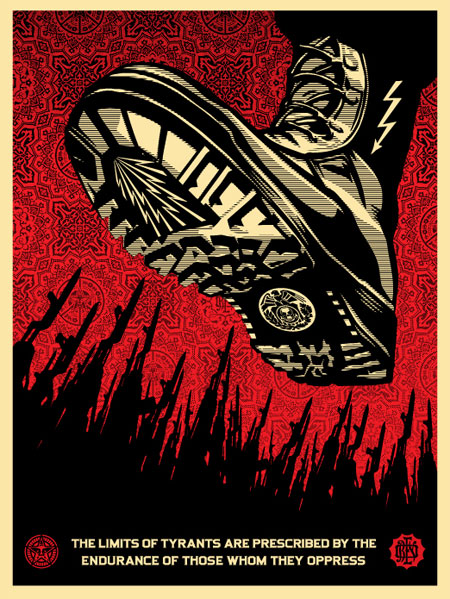
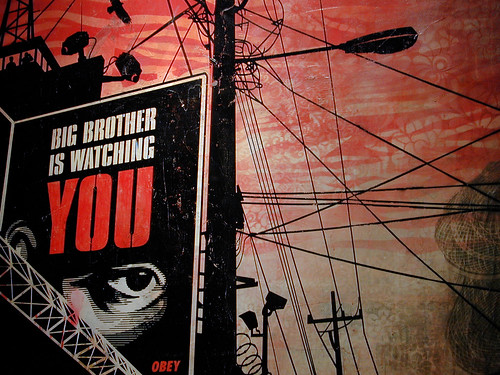
19. This is not required, but you might find it interesting - the poster images that I have been using come from a famous artist named Shepard Fairey. Fairey became famous for placing pictures of an ominous, Big Brother-esque face with the words "OBEY" across America in public places. He has since become a celebrity artist and has done several recognizable pieces, including the famous Barack Obama poster from the last election. You may wish to read more about his history or seek out more of his artwork online.

English II Honors - 1984 Book III and Appendix Questions

Hey guys!

By now you are finally realizing the magnitude of the political message in Orwell's 1984. Hopefully, the questions have been guiding your reading and it is all starting to make sense. With these final questions, you will be complete not only the assessment, but hopefully, your understanding of the novel, also.

There will be two additional assessments with the 1984 unit, beyond the workbook questions. You will be required to complete a propaganda poster (see the addendum to the workbook questions) and you will complete an analytical essay final similar to the final assessments for A Separate Peace and Julius Caesar.

The points breakdowns are as follows:

Workbook questions - 100 points each
Poster - 75 points
Essays - 200 points

Total: 575 points

The assessments will be due at the following times:

Workbook questions #1 - Nov. 17
Workbook questions #2 - Dec. 1
workbook questions #3 - Dec. 9

(December 8 will be the date of the English II Exam for all sophomore students)

Posters - Dec. 15
Final - Dec. 16

Nine weeks ends on Dec. 19.

BOOK III Questions


1. How would you feel if you were in Winston's shoes at the start of Book III? Are there any parallels that you can draw in your own life to try to understand his situation? Write a 300 word response in which you consider these questions.
2. What devices did the state have for enforcing total control?
3. What is Big Brother?
4. What thoughts did the woman hanging clothes in the yard cause Winston to have?
5. How had Winston and Julia been spied on?
6. Describe Winston's cell.
7. What crime did Winston's first cell mate commit? His second?
8. What appears to be the ultimate torture?
9. What methods of forcing confessions are used in the Ministry of Love?
10. What is O'Brien's job? How does this change our opinions of him?
11. Give one of Winston's "hallucinations" about the past?
12. Why does the party cling to power?
13. What is the picture of the future according to O'Brien?
14. What demonstrates the ultimate breakdown of Winston's rebellion?
15. How did Winston train himself to crimestop?
16. What sent Winston to Room 101? What is his ultimate terror?
17. Why did Winston and Julia not carry on their relationship after meeting again?
18. People are often shocked at the sexual content in 1984. Why does sex play such a large role in the novel? What could Orwell be suggesting by having Big Brother try to manipulate and control that part of people's lives?
19. What is the last sentence of 1984? What does it mean?
20. What are your final thoughts after having read the book? Write a 300-word minimum response in which you can discuss thoughts, feelings and details about the novel that you found difficult, interesting, profound, etc.

ADDENDUM: POSTER PROJECT

"Propaganda is aimed at influencing the opinions or behaviors of large numbers of people. As opposed to impartially providing information, propaganda in its most basic sense presents information in order to influence its audience. Propaganda often presents facts selectively (thus lying by omission) to encourage a particular synthesis, or gives loaded messages in order to produce an emotional rather than rational response to the information presented. The desired result is a change of the cognitive narrative of the subject in the target audience to further a political agenda.
Propaganda is the deliberate, systematic attempt to shape perceptions, manipulate cognitions, and direct behavior to achieve a response that furthers the desired intent of the propagandist."
—Garth S. Jowett and Victoria O'Donnell, Propaganda and Persuasion

As you know, we have been reading 1984, which features a great deal of propaganda in it. The propaganda era reached a zenith during World War II, which finished only four years before this novel was first published.

Read more about propaganda, and see examples, here: http://www.teacheroz.com/WWIIpropaganda.htm

I have shown you some more modern interpretations of propaganda in the works of Shepard Fairey. Fairey is a politically-minded street artist who has created some of the most compelling works of art of our time.

Using the knowledge that you have gained about propaganda, you are to create a propaganda poster of your own that will be displayed in our classroom and in areas around the school. You may do a modern revisioning of a an old poster, or you may create a new one. For example, the school has cameras everywhere - a poster with a picture of one and the message "Big Brother is Still Watching" would not only make an attractive poster, but provide a thought-provoking message, too.

You poster is to be completed on a poster-sized sheet of paper, and can be incorporate any medium - paint, photography, drawing, screen printing, etc.


Good Luck!

Monday, October 27, 2008

English II Honors - Creative Writing Activity


Hey guys!
Now that you have completed the dialogue activity and your narrative drafts, I am going to be spending a good deal of time with each of you individually on conferencing with your pieces. This is a time-consuming process, and is an important step to take before the rewriting process begins.
During this time, I would like you to complete the following assignment. On the surface, it appears quite morbid; however, with a little imagination, I think you can see that it is a worthwhile personal creative writing topic that ties in well with our current unit.

TASK

A eulogy is a speech or writing in praise of a person or thing. The word is derived from the Greek word εὐλογία (eulogia), meaning praise (εὐ meaning good or well and λογος meaning word, phrase, speech, etc).

The term "eulogy" may refer to a funeral oration given in tribute to a person or people who have recently died.[1] Eulogies may be given as part of funeral services, however some denominations either discourage or do not permit eulogies at services to maintain respect for traditions.

As a class, we have been privy to one of the greatest speeches ever given at a funeral - that of Mark Antony at the funeral of Caesar in Shakespeare's Julius Caesar. Simultaneously admonishing the conspirators in Caesar's murder, reminding the people of Rome of the debt they owed Caesar, and calling them to avenge his death, the speech is a remarkable example of how a person can be remembered at a funeral.

You are to write your own eulogy for this assignment. Think about it...if you had one last speech to give, and the people that mattered most to you were packed into the room, what would you say? What would you want to get across? Would you simply thank your family, or would you discuss and reflect on what your life was like and what you tried to do with it?

There are many eulogy websites out there to assist you with this assignment. I suggest that you Google two or three, read some famous eulogies, and get a sense of what I am asking you to do before you begin writing. 

The length of this assignment is 700-1000 words. Here is the caveat - you will not submit your paper - you will be asked to give your eulogy in class, as a speech. Your assignment is due Monday, Nov. 3, and from that point on, I will be having each of you stand in front of the class and give your eulogy. YOUR SCORE WILL NOT REGISTER UNLESS YOU READ IT IN FRONT OF THE CLASS - SEE ME IF THIS POSES A SIGNIFICANT ISSUE, AND WE WILL ADDRESS IT.

Thursday, October 23, 2008

English II Honors - Dynamic Dialogue Writing Activity


Hey guys!

Sorry I won't be here today - I will be on a field trip to Lexington to tour the Herald-Leader newsroom with my Journalism class. While I am gone, I would like you to begin working on this dialogue activity that will help you to craft better dialogue in your stories. It is due on Tuesday.

DO NOT FORGET - NARRATIVE DRAFTS ARE DUE ON MONDAY. PRIORITIZE YOUR TIME...YOU WILL NOT HAVE TIME IN CLASS TO WORK ON THESE ON MONDAY. 


1. I would like you to explore the following link and read the Exercise labelled Exercise #1.
http://hollylisle.com/fm/Workshops/dialogue-workshop.html

2. Then complete Exercise #2.

This is to be submitted by Tuesday, Oct. 28. Minimum wordcount on Exercise #2 will be 400 words. Make sure that you include a title for your dialogue activity. Exercises are to be posted to Blogspot no later than when you are to arrive in class on Tuesday.

Thanks and good luck!
Mr. Parsons

Friday, October 17, 2008

English II Honors - Descriptive Writing Activity


Hey guys! 

I will be in and out of the classroom today working on the photography for our Postsecret Project, so I wanted to give you guys something to work on that would be creative, fun, and linked to the unit we are working on.

Personal narratives need to be very descriptive - the places, the people, the events, and the feelings involved all have to be explained with great accuracy and using beautiful language. For this exercise, I want you to work on your descriptiveness - the ability to delineate the characteristics of something, good and bad, and explain it to the world.

Please complete the following activity. It will be due on Monday, posted or handwritten. 

Like the Back of My Hand

Your task is to describe your hands in as much detail as possible. A page would be considered an appropriate length for this activity.

You may answer the following questions, or find other creative ways to express your descriptiveness.

1. Do you have any white spots on your nails? Which ones?
2. If your hands were flat in front of you, would the tip of your thumb reach the second knuckle on your index finger?
3. Are your fingers hairy, or devoid of hair?
4. Do your fingers have any scars or marks? How did you get them?
5. Which is longer, your index finger or your ring finger?
6. Do you have freckles or moles on your hands?
7. Are your fingers or hands callused? Why?
8. Do you bite your fingernails? Paint them? Are they dirty?
9. When your index finger is stretched out, how many wrinkles do you have in your middle knuckle?
10. Are the lines on the inside of the hand prominent?
11.  Are your hands big or small?

DO NOT SIMPLY ANSWER THE QUESTIONS - THIS ASSIGNMENT IS TO BE WRITTEN IN THE FORM OF A NARRATIVE, WITH A BEGINNING, MIDDLE, AND CONCLUSION.

Good luck on this activity...hope you find your descriptive abilities quite handy (Pun intended...groans optional).

Tuesday, October 14, 2008

English II - Transactive Writing Genre Characteristics

Hey Guys!

As you know, today we have been looking at transactive writing - the form of writing in which information is actively transferred between the writer and the reader. 

I have detailed the kinds of transactive writing that we will be looking at this year - news articles, feature articles, reviews, persuasive letters and editorials, and speeches. I would now like you to get a better understanding of the genres by reading several examples of each online.

1. Find three examples of each kind of transactive writing online.

2. Complete the following information for EACH example:

- Who wrote it?
- Where was it published? (Include URL and description)
- What is the purpose?
- Who is the audience?
- Summarize the information that is being shared with the reader.

3. Write a multi-paragraph entry on the differences you were able to notice between the genre types.